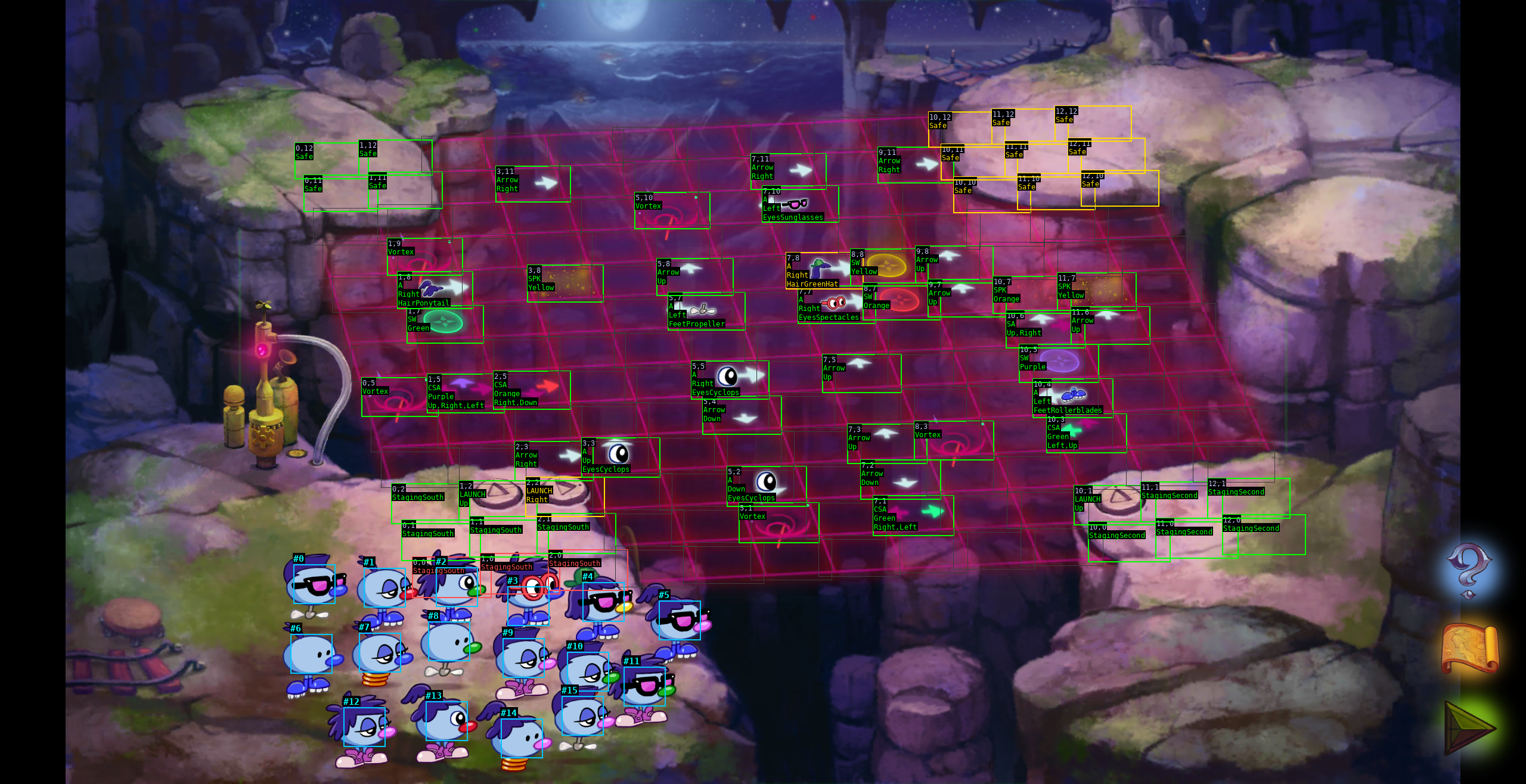
Old revived blog post I originally made this blog post in 2025 in “the before times”, before AI took over the world.
It was multiple parts, and … boring.
This is a consolidated post, revived thanks to AI assisting me in writing the hardest part of the code, bringing this project over the finish line.
The blog post itself is NOT written by AI.
Intro I’ve built a tool-assisted autosolver to solve the Bubblewonder Abyss level of the Logical Journey of the Zoombinis:
Previously I wrote about getting a new version of the Linux kernel booting on my favorite phone of all time, the Palm PVG100 (pepito).
This blog post is about my (enormous) effort of porting Lineage 23.2 (Android 16) to the phone, running version 4.19 of the Linux Kernel.
I'll upgrade your phone Did you stumble onto this post just because you own a Palm PVG100, and you’re not into all this techno mumbo jumbo?
I’ve been bringing up my Palm PVG100 to run on Android 16 using a custom ROM.
In doing so, I’ve been wondering how good I could get its tiny tiny tiny battery to last.
Also, I wanted to make sure my new ROM didn’t have any serious battery life regressions compared to the stock Android 8 OS.
So I decided to be scientific about it and actually measure.
Phone Coulomb Counters All mobile phones have a Coulomb counter so that they can measure how much battery life they have.
I’ve blogged about my favorite phone of all time, the Palm PVG100, before:
And while I successfully upgraded it to Android 11, that still is pretty old (and with the stock kernel). The phone came out in 2018 with Android 8.1. Android 11 came out in 2020.
I just love this phone so much. I wondered, what would it take to upgrade this thing to the latest Android 16 (2026)?
I’ve been debugging computers for my whole life.
One of my earliest computer debugging memories was splicing my own null modem (serial) cable connecting two 386s to play DOOM with my brother. With no internet or manuals, I somehow figured out how to run dm.exe and get it working over 100’ for lots of summer fun.
[Picture of my brother and me stringing a 100-foot-long, masking-tape-wrapped bundle of mismatched wires across the house in 1995 unavailable]
I’ve written before about getting custom motorized blinds for all my windows at my new house.
They are great. So for my new Dream Office, I wanted to also have blinds, but I wanted them to be “perfect”.
Perfect here means: I never want to have to adjust them, they should do exactly what I would have done, as if they were reading my mind.
Here are my rules:
Default to open, maximize light if possible Lower (but not fully close) the shades to prevent direct sunlight from pouring in more than a foot past the window sill Stay open during rainy days Close at night for privacy Of course we won’t be able to do these things without some automation.
I have a first gen Silhouette Portrait hobby cutter that I’ve had for over a decade.
It is great!
It can cut heavy cardstock up to 8.5" wide. I’ve used it to cut many different projects over the years:
Jellyfish Wall Art Etched Metal Straws Sutro Tower Vinyl Art 3d Paper Homes And here I’m cutting custom mini mats for an eInk display in a frame:
But I’ve always resorted to using Windows/Mac to run the software.
Bloom’s Taxonomy is one of my favorite models for how we learn.
The big idea here is that, as we learn, we build on each lower layer of the pyramid towards higher order functions.
It is a pretty standard way of teaching things. First through repetition, we remember concepts. Eventually we can apply our understanding and answer questions. Finally we can create, building upon all the lower levels.
Often we use the word pedagogy to refer to the study of how we learn things.
I remember when I was young watching “Star Trek: The Next Generation” (TNG), and thinking about how cool it would be to talk to Data (the android).
I particularly remember thinking hard about the episode where a kid admires and looks up to Data so much, that he pretends to be like him in every way (including being emotionless).
I also really remember “Data’s Day”, which gives you a narrative (Data narrates) view of what Data’s … day is like.
I recently have had the pleasure to use a TUXEDO Stellaris 16 - Gen 7 laptop.
The main reason I’m using this laptop is for the Linux support, which is superb.
Another reason is because it is just super cool! Literally!
One of its accessories is the Aquaris water cooler.
Let’s look at it under a thermal camera, for fun.
The Aquaris Unit The Stellaris 16 is a Clevo laptop. It goes by a few names.