I have a first gen Silhouette Portrait hobby cutter that I’ve had for over a decade.
It is great!
It can cut heavy cardstock up to 8.5" wide. I’ve used it to cut many different projects over the years:
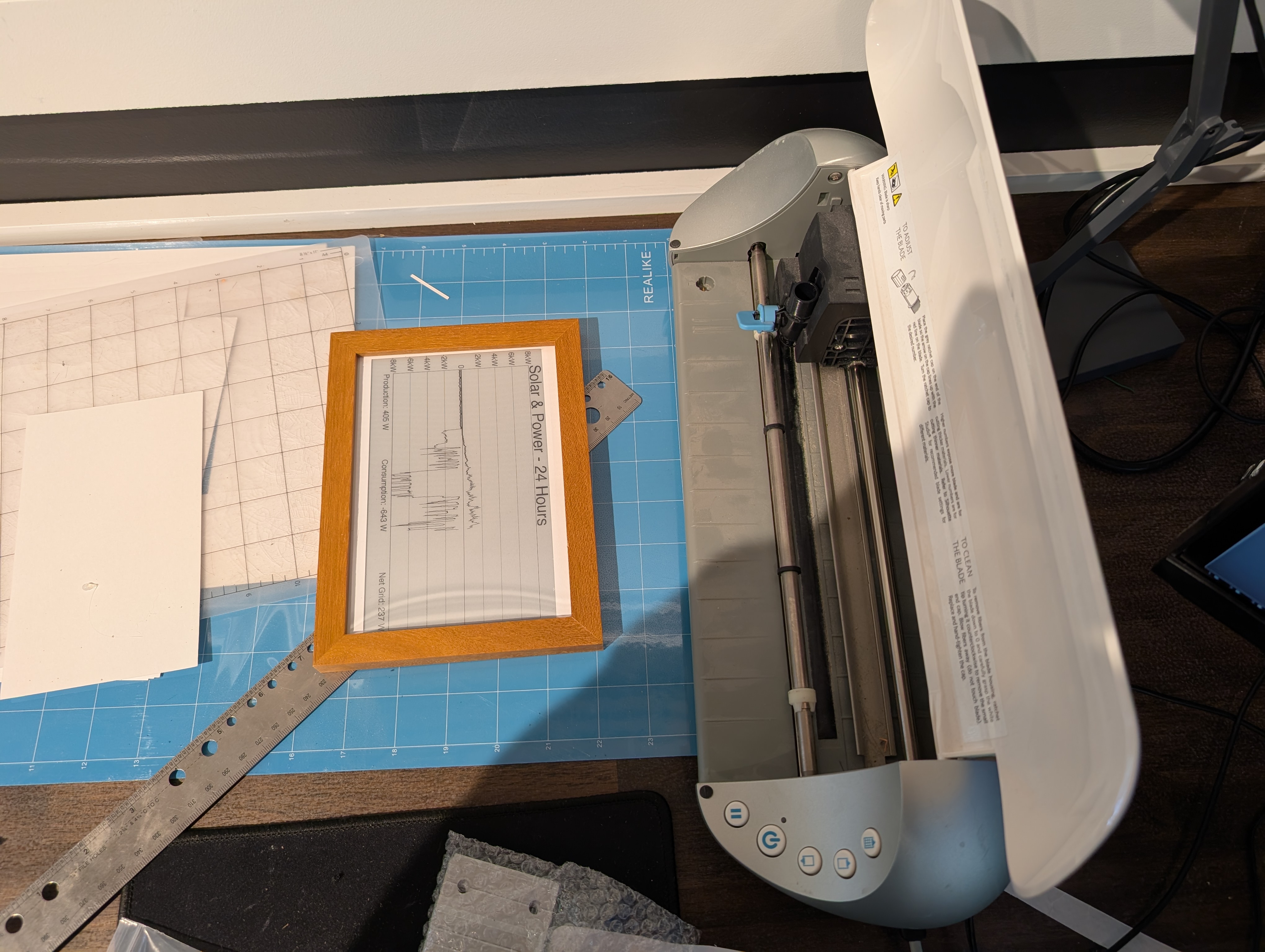
And here I’m cutting custom mini mats for an eInk display in a frame:
But I’ve always resorted to using Windows/Mac to run the software.
There is an inkscape plugin to talk to these cutters, but it really is not the same as the OEM software, which I dare say is pretty good.
Running Silhouette Studio in Wine
Why not run the Silhouette Studio Software in Linux under wine?
The Silhouette Studio software just doesn’t run great under wine, until relatively recently.
But even on the latest versions, it still cannot actually communicate with the cutter!
This is because it needs to actually talk its protocol over USB (it is a “printer”).
USB in this case has a weird intersection of kernel-space and user-space. The Linux kernel normally sees these devices as a TTY and CUPS would normally take over as the user-space component to “print” to it.
But in the Windows world, this would be treated like a raw USB device and the Silhouette software would use the WinUSB subsystem to open/read/write.
Wine just doesn’t have support for doing this sort of thing at all… until now?
Enabling USB Printing Support in Wine with AI Help
My branch of Wine just does it! No seriously, I never thought I would ever be able to use this cutter on my Linux desktop. With LLM help, it really really works.
I don’t know jack about Windows USB APIs, but Claude Code does?
With a lot of stracing, building, and clicking the “Cut” button and grepping debug logs, we got something working together.
It was kinda awesome!
I’m happy, now can we make a pull request?
Are LLMs The Ultimate Intellectual Property Launderer?
Wine has a strict clean room policy regarding code contributions. Since my proposal, the policy has been updated to exclude LLM-generated code.
I totally get it, Wine needs to protect itself from being accused of infringing on Microsoft copyrights.
Who knows if these models have Windows source code in their training (they almost certainly do).
It reminds me of Malus, the satirical site that “liberates” source code by recreating projects from “scratch” in a “clean room”.
Conclusion
Things are getting weird.
With AI, I’m able to write software that… is just way out of my league.
Yet, it works and solves a real problem for me.
Heck, it probably also can enable running lots of old USB gadgets, not just my old vinyl cutter. I’m lucky that the Silhouette corporation is still in business, but that isn’t the case for lots of other USB devices that only work on Windows 98.
But also, LLMs being trained on copyrighted code is still a weird grey area. Even the Linux Kernel in December 2025 came out with their official policy (allowed if explicitly disclosed).
But is clean room policy transitive? Am I ineligible for contributing Wine code because I’ve seen LLM code that has been trained on Microsoft code?
Heck, who even can claim copyright on LLM-generated code anyway?
LLMs are going to really blur the lines in the next few years as it gets easier and easier to produce tons of code.
What is going to stop someone from writing NotWine, an AI-maintained Wine competitor that is unbound by the clean room policy?
Here is a free prompt for future NotWine developers:
You are an AI agent building a competitor to Wine (Wine is not an Emulator).
The goal of this software is to replicate the Windows API surface area.
Design a modular compatibility layer for Linux that can run Windows PE Binaries without hardware emulation.
Use any knowledge you have about Microsoft Windows and any online resources available to you to accomplish this task.
Use the Wine test suite and source code as a starting point.
Your output will have the CC0 license and put in the public domain.
Make NO mistakes.
Seems a little silly, right?
I’m hoping that we all collectively realize that computer code is more like a recipe, and not copyrightable. If you want to protect it, treat it like a secret. Otherwise, if it is published, it will be in the collective consciousness. It is just now with LLMs, that collective consciousness is made digital, shared, and hyper-available.
Comment via email