In 1983, Datamation magazine published a satirical letter called “Real Programmers Don’t Use PASCAL”. It divided programmers into two groups: “Real Programmers”, who code in FORTRAN, and “Quiche Eaters”, who use Pascal and don’t really understand programming.
Sound familiar?
The letter was written by Ed Post, and it’s where the phrase “Real Programmer” comes from. The name “Quiche Eater” is a nod to the 1982 bestseller Real Men Don’t Eat Quiche.
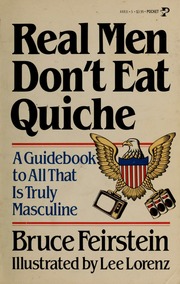
I remember seeing this book when I was a kid, but I’ve never read it.
(In case it doesn’t land immediately, the analogy here is that the “Real Programmers” today are the ones that don’t use AI, and the “Quiche Eaters are the ones that do use AI.)
The History of Mocking
It goes back further than that. When FORTRAN showed up in 1957, serious programmers didn’t trust it. Real programmers hand-wrote assembly, and everyone knew a compiler could NEVER match code squeezed out by a human who understood the machine. Right?
FORTRAN’s compiler eventually turned out code nearly as fast as a human’s, and the argument evaporated.
So the sneer moved up a level. By 2009 the joke had come around again, and this time C was the real language: “Real Men Program in C”. The language that was once for quiche eaters had become the badge of toughness.
What will it be next?
It’s Happening Again
We (the industry) made fun of Pascal coders in the same way that we make fun of “vibe coders” now.
At this exact moment there’s a big divide among engineers. On one side are the ones who resist AI and only accept human-written code. On the other side are the ones using AI who don’t even bother to look at the code that comes out.
Heck, I use AI to write code all the time, in programming languages I don’t even know!
Forty years ago I would have been the “quiche eater” for sure.
This Is a Special Time
The thing is, this won’t last long. It’s easy to make fun of AI-written code right NOW. But it’s getting harder to do that.
Most engineers right now aren’t using the most sophisticated (and most expensive) cutting-edge models for writing code. They are using the cheap ones, or the low-grade ones that their employer blesses.
But this is only temporary. As the models improve, the jokes are going to land less and less.
Of course, “Vibe coding” is transitioning to “agentic engineering”.
What’s it going to be like when there’s no question that an AI model can write better code than a human can? What’s it going to be like when we’re over the hump and look at artisanally written code the same way we look at vibe-coded applications now?
The Not So Distant Future
Why would we expect a human to be better than a computer when it comes to writing COMPUTER code anyway?
It’s very easy for me to imagine a future where we see all human-written code as worse than AI-written code.
Mostly because I’m just not very good at writing code! The bar just isn’t very high for me.
There will always be a very small percentage of extremely proficient engineers who can write niche code better than an AI could. But don’t hold your breath. It’s like hand-tuned assembly: most of the time you can’t beat your compiler, except in very special cases.
But Kyle, LLMs Are NOT Compilers!
It’s true: LLMs are fundamentally very different from deterministic compilers.
On the surface it looks like another compiler revolution, but it isn’t really. It is just a new and different thing.
So, you are right (LLMs are not compilers), but it doesn’t matter.
Almost nobody reads the assembly their compiler emits. You judge it by whether the program works: the tests pass, it runs fast enough, and it does what you asked. That’s exactly how we will judge AI-written code, even if it isn’t deterministic.
They (LLMs) are still (going to be) better than you at writing code.
But What About Taste?
“Everybody can be a 10x engineer now, as long as you have people with good software taste. - Emma Tang, head of data infrastructure at OpenAI, as quoted here.
There are plenty of others claiming that “taste” is the thing that humans are here to provide when writing code.
I think this is silly, and taste is just a tiny moat that will not last long.
Just like every other “computers will never be able to do X” statement, there is no reason LLMs can’t develop good taste when it comes to software engineering.
Conclusion
The tech is changing faster than your opinions can.
Every generation of “Real Programmers” has been sure the new tool was for quiche eaters, and every generation has been wrong. Today’s sneer at vibe coders is the same joke, told for the Nth time.
Try keeping things in perspective with this silly timeline:
You are in the red sliver right now, in 2026.