I think that there’s a small but growing contingent of humans on this planet who are completely delegating their thinking to AI.12
I’m not talking about just having AI assist you in checking your email and buying plane tickets. I’m talking about full thought replacement. I’m talking about just asking for AI help for everything and turning off the critical thinking part of your brain.
It reminds me of the Twilight Zone episode “Nick of Time” (1960), starring William Shatner.
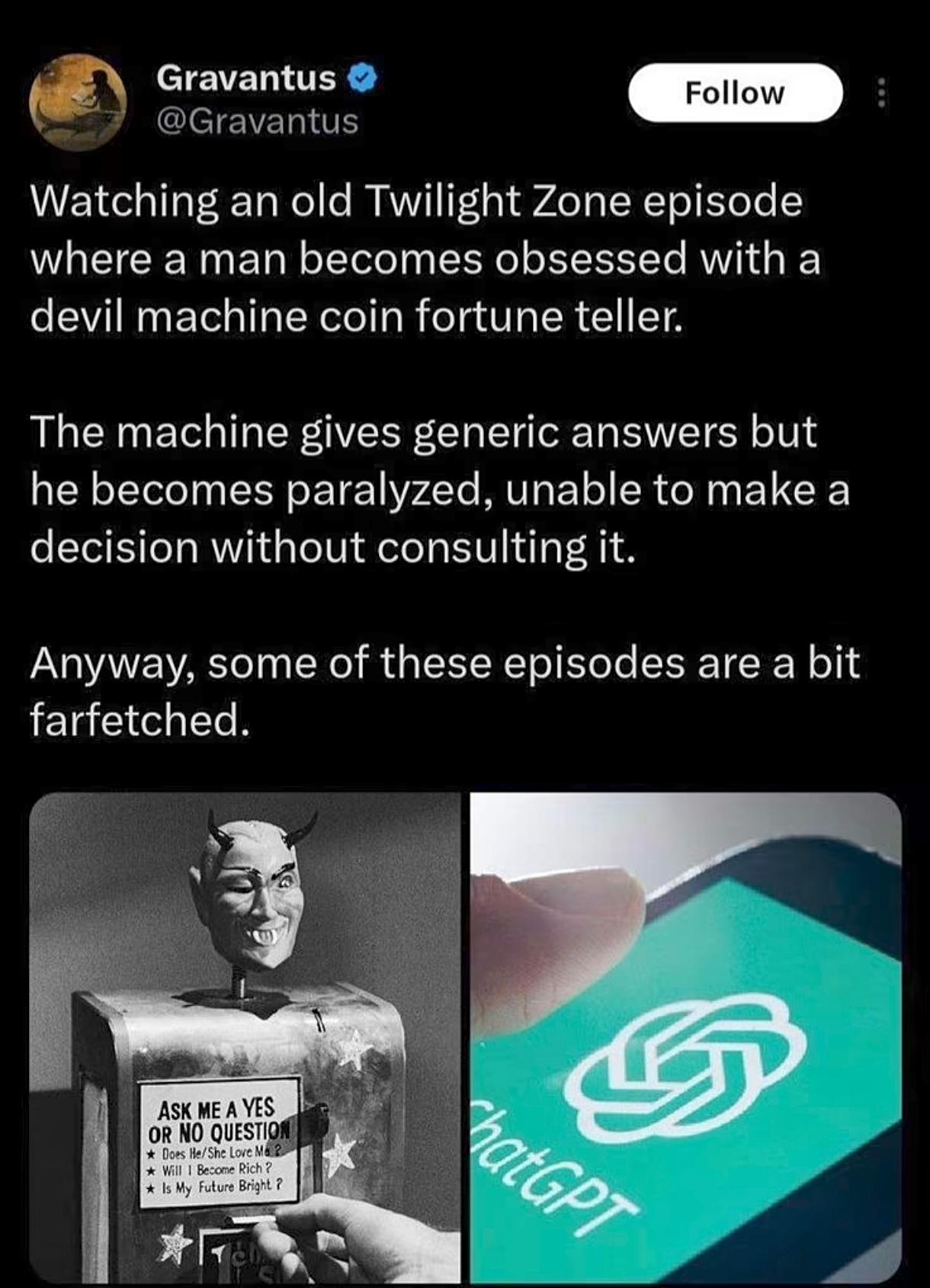
I totally understand the appeal. Thinking is hard. From even a biological perspective it does make sense to just not do it if you can.
But what is the world going to look like if this continues?
Check out this video of a ChatGPT-written speech:
Writing speeches is hard. LLMs are good at it. Why not have an AI for your speechwriter?
Take a look at this video of this guy using ChatGPT to grade incoming papers.
Seriously, I get it. ChatGPT is probably faster and better at paying attention and grading these papers. Probably.
When you think about it, it’s a little silly for students to use ChatGPT to write their papers, only for them to be fed back to a TA who uses ChatGPT to grade those papers.
But I don’t do this.
Of course, I would never do this.
I would call outsourcing your thinking to AI what the kids call “cringe”.
It’s embarrassing to me to have a proxy for thought. A meat proxy, as they say.
But then again, am I not doing this constantly when I do LLM-assisted software engineering? AKA vibe coding, AKA agentic engineering?
But doesn’t it seem hypocritical? I would never let ChatGPT write my emails, but I don’t mind it writing all my commit messages and all of my source code?
Honestly, I can’t really think of a fundamental difference between these, except for the fact that in the email case, that prose is going to another human. In the code case, it’s going less and less back to humans and more and more back to other LLMs.
But then again, what’s the world going to be like when it’s just one person’s ChatGPT talking to another person’s ChatGPT over email?
I do find it surreal catching myself talking like Claude sometimes. It’s even more surreal talking to software engineers and hearing Claudeisms come from them.
It seems natural that if you talk with something for hours a day, you’re going to pick up its mannerisms. It’s just that we’re all talking to the same thing for hours out of the day. So we all… sync up.
When the world collectively parrots AI
The thing is, for the most part, AI is prompted to be helpful and useful, perhaps with the exception of Grok.
Regardless of which LLM you actually use, it ends up being about the same helpful voice.
I’m also not just talking about style and word choice. I’m also talking about political leaning. Everyone knows that reality has a well-known liberal bias.
Maybe the future isn’t so bad. It may sound weird and cringy, but overall probably positive?
Cascading up effects
I think the most interesting effects happen as AI takes over the voice of politicians and leaders.
It’ll be slow and subtle, but encoded AI values will seep into speeches and any English copy.
Won’t it be a weird day when the majority of senators are using AI to help them decide how to vote, and they all end up voting to end climate change, because ChatGPT told them to?
Social pressures as cohorts change
Right now it’s very obvious when someone’s using AI to write their emails. You can see them reach for their phone when they need to make a decision.
Over time this is going to get more ubiquitous.
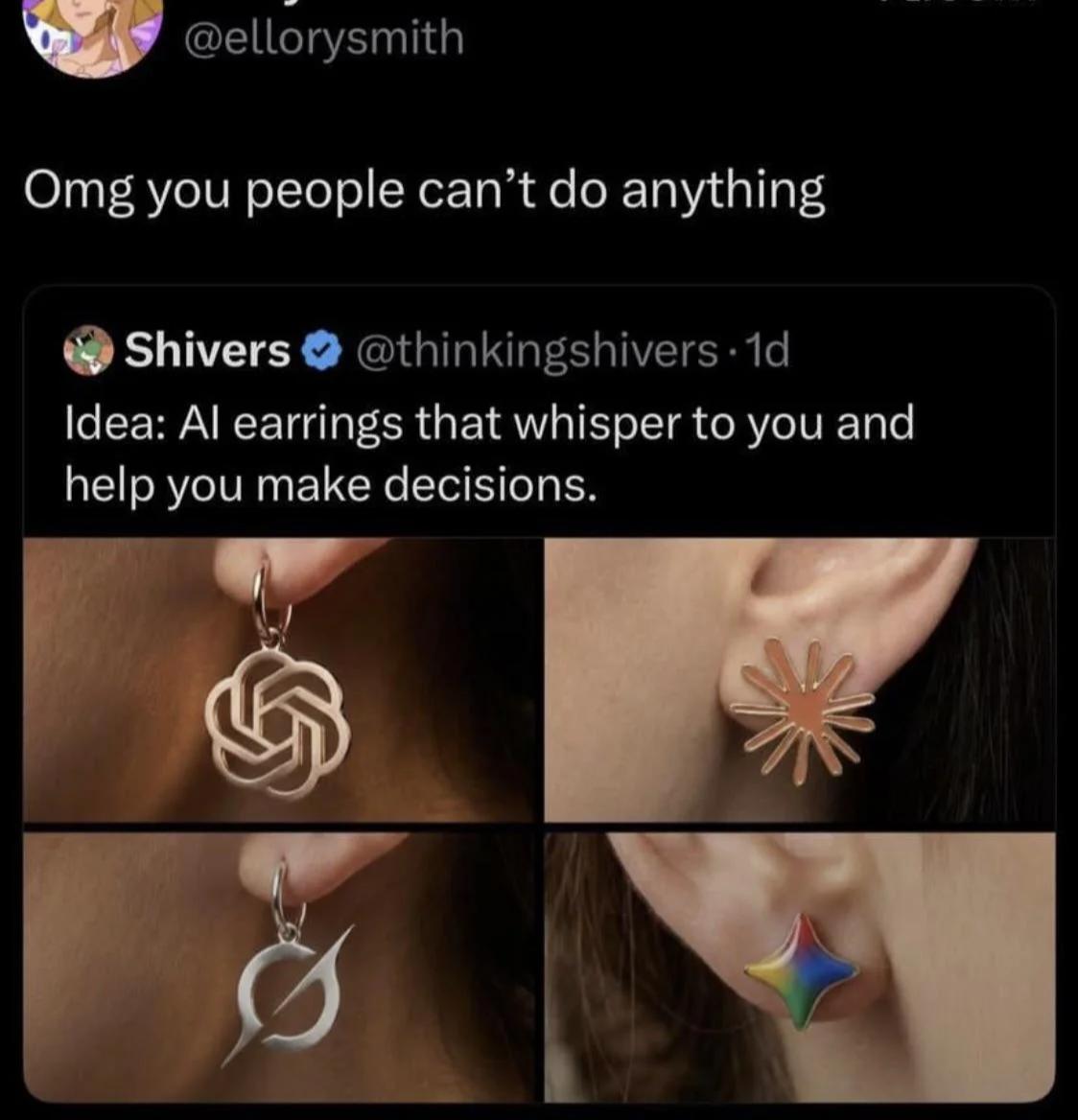
AI pins, XR glasses, etc. It’s just going to get easier and easier to lean on AI all the time.
It’s going to get weird when we hit the halfway mark. Half will be using AI continuously for every thought and interaction, and the other half won’t, or perhaps will just use AI when they’re at a big computer?

It’s going to get weird
As more people lean on AI for thinking and writing, there will be more groupthink, but hopefully with just the good aspects of groupthink, not the bad stuff.
What we consider cringy now will become the norm when it comes to AI-written speech.
There will be a new class of intellectual, or perhaps a rebranding of what it means to be an intellectual.
Intellectual: One who DOESN’T use ChatGPT to think?
Honestly, maybe it’s for the best? In the same way that I was never really that good at writing computer code, and now I’m happy that I can delegate to AI for that, perhaps it’s for the best for those who don’t feel like thinking to lean on AI for that.
AI blackouts
This would be a good time to make the case that this is bad, because what happens when AI goes down?
Is the everyday user going to be able to flex that atrophied muscle that is their brain and figure out how to read a map?
When I think about this, I’m reminded of the first episode of James Burke’s Connections.
In the case of a sustained (years) electrical blackout, he argues that we’d have to go learn how to use the plow again. But nobody knows how to use a plow anymore. We’re hopelessly dependent on the system.
It’s already the case now that we’re hopelessly dependent on the internet, electricity and computers to live our daily lives. We can survive short blackouts, but not long ones. I don’t think AI changes the calculus here.
Conclusion
I’m optimistic that AI replacing people’s thinking will, on the whole, be better for everyone.
If you can survive the transition and bear with the idiosyncrasies, then I’d like to think that AI will raise all boats here.
I hope that Martin Fowler’s LLM Voice post is just a temporary bump that won’t age well. Just like “You’re absolutely right” is no longer a thing.
I’d like to think that I’m of the older generation and that I’ll never change. Never allowing AI to replace my thinking and voice.
And yet AI writes all of my computer code now. I’ve already delegated much of what my brain used to do (writing computer code) to AI.
It’s just I was hoping the AI would be replacing me doing the laundry before it replaced me doing the thinking.
-
MIT Media Lab, Your Brain on ChatGPT: Accumulation of Cognitive Debt when Using an AI Assistant for Essay Writing Task (2025). EEG showed lower brain engagement in people writing essays with ChatGPT. ↩︎
-
Microsoft Research and Carnegie Mellon, The Impact of Generative AI on Critical Thinking (CHI 2025). ↩︎
Comment via email